
New York's Freedom of Information Law
New York's open-records law is the Freedom of Information Law, known as FOIL. It lives in Public Officers Law Article 6, sections 84 through 90. FOIL gives the public a right to access records held by state and local agencies, with named exceptions. In Monroe County, that means county departments, the Sheriff's administrative records, and District Attorney administrative files fall under FOIL.
Anyone can file a FOIL request, and you do not have to explain why you want the records. The law treats a record broadly, covering documents, data, emails, and other agency materials, unless an exemption applies. Public Officers Law section 87 sets the access rules and the exemptions, and section 89 sets the procedure for requests, denials, and appeals. The state's Committee on Open Government oversees the FOIL framework and publishes guidance, which makes it a useful reference when an agency and a requester disagree about access.
FOIL Records vs Court Records
Here is the part people miss. Court records are not requested under FOIL. The New York court system is explicit that access to court files is governed by Judiciary Law section 255 and clerk duties, not by FOIL. So a request for a Monroe County court case goes to the clerk that holds it, not through a FOIL letter to an agency.
| Agency Records | Court Records | |
|---|---|---|
| Law | FOIL, Public Officers Law Article 6 | Judiciary Law section 255 |
| Examples | Sheriff admin, county departments, DA admin | Civil, criminal, family, estate case files |
| Where to Ask | The agency's records access officer | The County Clerk or the court clerk |
| Appeal | Agency head, then Article 78 | Court order for sealed or restricted files |
The image below shows Judiciary Law section 255, the statute behind court-record requests.
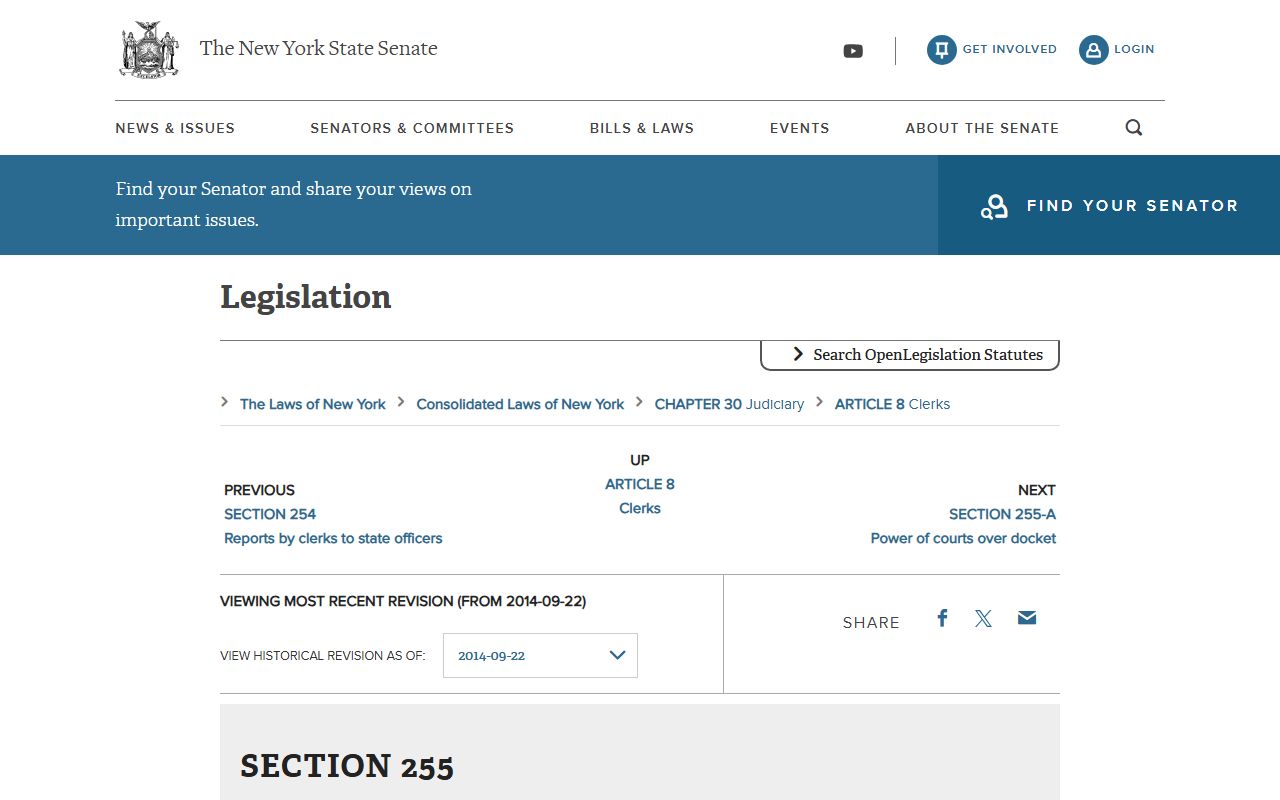
Section 255 directs the clerk to search the files and provide copies on payment of the statutory fees. The court records page covers that process in full.
What the Monroe County Clerk Maintains
The Monroe County Clerk is both the Clerk of Supreme and County Courts and the county's recorder of land and related records. That dual role means the Clerk holds a wide range of records beyond court files. The list below covers the main categories.
- Supreme and County Court civil and felony files.
- Deeds, mortgages, mortgage assignments, and satisfactions.
- Judgments and liens.
- Certificates of disposition for criminal cases.
- Business names (DBA), notary, and pistol permit records.
- Passports, DMV services, and veterans discharge filings.
The Clerk also runs an online records database, SearchIQS, for indexed public court and land records, and accepts e-filing through NYSCEF where it applies. So some of these records can be searched online before any in-person request.
Note: Birth, death, and marriage certificates are not kept by the County Clerk; those come from local clerks or state vital records.
Sheriff and Agency Records Under FOIL
A lot of useful Monroe County material is agency record, not court record, so FOIL is the right tool. The Sheriff's administrative files, county department records, and the District Attorney's administrative files all fall under FOIL. That can include policies, contracts, budgets, statistics, and similar agency documents, subject to the law's exemptions.
Jail custody data is a special case. The Sheriff already publishes the roster, census, received, and released reports as daily PDFs, so you usually do not need a FOIL request to see who is in custody. For records the Sheriff does not post, a FOIL request to the Sheriff's records access officer is the path. The same logic applies to other county offices: check what is already published before you file.
How to File a Public Records Request in Monroe County
For agency records, you send a FOIL request to that agency's records access officer. For court or land records, you contact the County Clerk instead. Either way, a clear description speeds the answer.
- Decide which track applies: FOIL for an agency record, the County Clerk for a court or land record.
- Identify the right office and its records access officer or customer service desk.
- Describe the records as specifically as you can, with names, dates, and any case or index number.
- Submit by mail, fax, email, or in person, depending on the office's accepted methods.
- Wait for the response, then pay any fees and receive the records.
The County Clerk takes requests in person, by phone at 585-753-1600, by fax at 585-753-1650, and by mail to 39 West Main Street, Room 105, Rochester, NY 14614. A FOIL request can be a short letter or email; you do not need a special form, only a clear description of the records and your contact information.
Public Records Request Fields
Whether you use a FOIL form or a Clerk request, the information needed is similar. Give enough detail to find the record without making the search guesswork. The table below lists the common fields.
| Field | Required | Notes |
|---|---|---|
| Requester Name and Contact | Yes | So the office can reach you with the cost |
| Description of Records | Yes | Names, case or index number, document type |
| Date Range | No | Narrows a search and lowers the fee |
| Format Preference | No | Paper, certified copy, or electronic |
| Identification | Conditional | Required for sealed or restricted files |
Response Timelines
Under FOIL, an agency must respond promptly. Public Officers Law section 89 requires the agency to acknowledge a request within five business days and then grant it, deny it, or state a reasonable date by which it will respond. A delay must come with a date, not silence. Court and land record requests through the County Clerk move on the office's own schedule, which depends on whether staff must search older files.
Note: If staff at the County Clerk must search for a file, the office charges $5 for every two years searched, so a tight date range keeps both the time and the cost down.
Monroe County Records Fees
Fees depend on the office and the record. The County Clerk publishes a clear schedule for court and land record copies, shown below. FOIL agencies charge for copies under the open-records law and may charge preparation time for large electronic requests. Always confirm the cost before the office runs the job.
| Item | Amount |
|---|---|
| Plain copy, per page | $0.65 (minimum $1.30) |
| Certified copy, up to 4 pages | $5 |
| Certified copy, each added page | $1.25 |
| File search, per 2 years searched | $5 |
| Criminal certificate of disposition | $5 |
Records That Are Exempt
Not every record is open. FOIL itself exempts categories under Public Officers Law section 87, including certain law-enforcement records, personal privacy material, inter-agency drafts, trade secrets, and records that would endanger safety. On top of that, separate statutes seal whole categories of court and clinical records, and those rules apply no matter which track you use.
Clinical records are protected under Mental Hygiene Law section 33.13. The image below shows that statute.
Sex offense victim identifying information is confidential under Civil Rights Law section 50-b, shown below. Sealed criminal cases, juvenile matters, matrimonial files, and adoption records are also off limits without a court order.
So an open-records request will not reach these files, and an agency that holds a copy must withhold it too. The court records page covers the sealing statutes in more detail.
If Your Request Is Denied
A FOIL denial is not the end. You may appeal in writing to the agency head or the designated appeals officer, who must respond within the time the law sets. New York's Committee on Open Government offers free advisory guidance on FOIL questions and disputes. If an appeal fails, the next step is a court challenge under Article 78, the special proceeding used to review government action.
For a sealed or restricted court file, the route is different. Instead of a FOIL appeal, a nonparty asks the court that holds the file for an order granting access. The petition goes to that court, and identification is required at the counter.
Keep your paper trail. Save the date you filed, any acknowledgment, and the denial letter. Those documents anchor an appeal and, if it comes to that, an Article 78 case. A clear, narrow request is also easier to defend on appeal than a broad one, since an agency can resist a request it calls overbroad.