
Arrest Records in Monroe County
Arrest records in Monroe County come from law enforcement, not the courts. The Monroe County Sheriff's Office books people into the county jail and keeps the custody data. City arrests run through the Rochester Police Department, and town and village police make arrests too. Once a person is booked, the Sheriff's Jail Bureau lists the custody on its public roster and census. Those reports are the closest thing the county has to a public arrest log. They show who is in custody now, the charge, and the court that will hear the case.
An arrest record is different from a criminal court record. The arrest record is the booking file: name, charge code, custody status, and court date. The court record is the case file that opens when a prosecutor files charges. The Monroe County Clerk holds felony conviction files for Supreme and County Court. Lower matters stay with the City Court or a town or village court. For the full case file, motions, and disposition, use the Monroe County court records page. This page stays on the arrest and booking side.
How to Search Monroe County Arrest Records
There is no single web form for Monroe County arrests. The Sheriff publishes custody reports as daily PDFs instead. The roster is an alphabetical list of who is in jail. The census is the detailed report, with charge, court, bail, and court date. Both update each weekday. For a pending criminal case after booking, the state WebCriminal portal lets you search by name across New York courts.
- Open the Sheriff's incarcerated individual page and pick the roster or census report.
- Scan the alphabetical list for the last name, then read across to the charge and court fields.
- For a case that is already charged, run the name through WebCriminal to find the court, docket number, and next date.
- For a felony conviction file, request records or a certificate of disposition from the Monroe County Clerk.
New York does not run a free public website that returns a person's full statewide criminal history. Pending criminal cases show in WebCriminal. Felony convictions filed in Monroe County are confirmed through the County Clerk's certificate of disposition. A true background check uses a different, regulated process.
What a Monroe County Arrest Record Shows
The jail census is the richest public booking record in Monroe County. It is a daily PDF, and each line packs in custody, charge, and court data. The roster is the lighter version, with just the name, jail number, and date of entry. Read the census when you want detail. The table below lists the fields a census line carries.
| Field | What It Shows |
|---|---|
| Name / JID | Last and first name plus the jail identifier number |
| Sex / Race | Coded values; no full date of birth on the census line |
| Custody Date / Time | When the person entered custody |
| Classification | Custody status, such as UNSENTENCED |
| Bail / Bond | Dollar amount set, if any |
| Court / Judge | Court code and assigned judge |
| Court Date | Next scheduled court date and time |
| Arrest Agency / Type | Arresting agency code, such as ROC or MSO |
| Charge / Description | Statute code, such as PL 215.52, plus a plain charge description |
What the census does not carry matters too. There is no mugshot, no height or weight, and no pod or cell location. The date of birth shows on the received and released reports rather than the census. So the public arrest data tells you the charge and the court, but stops short of a full personal profile.
The Monroe County Booking Process
Booking is the step that turns an arrest into a record. After an arrest, the person is taken to the Monroe County Jail at 130 South Plymouth Avenue in Rochester for processing. Staff record the charge, set custody type, and assign a jail number. From there the case moves to arraignment, where a judge addresses charges and release. Bail or bond, if set, shows on the census from that point.
Monroe County Jail
130 South Plymouth Ave.
Rochester, NY 14614
585-753-4178
Records: 585-753-4021
Sheriff Todd K. Baxter
Felony cases head toward County Court. Misdemeanors and violations stay with the Rochester City Court or a town or village court. The booking record is your earliest window into a case, often before any court file is searchable.
Arrest Records vs. Criminal Court Records
People mix these two up all the time. An arrest record is created at the jail when someone is booked. A criminal court record is created at the courthouse when charges are filed and a case opens. One is a custody record. The other is a case file. They can describe the same event, but they live in different offices and follow different access rules.
| Arrest Record | Criminal Court Record | |
|---|---|---|
| Source | Monroe County Sheriff / city or town police | County Clerk or court clerk |
| Created When | Booking into custody | Charges filed in court |
| Contents | Name, charge code, custody status, bail, court date | Pleadings, motions, orders, disposition, sentence |
| Where to Look | Sheriff roster and census PDFs | WebCriminal, County Clerk, court file room |
The jail census carries court fields, so it bridges the two. A census line can show the charge statute, the bail set, the judge, and the next court date. That makes it a useful first stop before the court file is even searchable online.
Charges vs. Convictions
A charge is an accusation. A conviction is the outcome. Being arrested and charged does not make a person guilty. Many arrests end in dismissal, reduction, or acquittal. The charge sits on the booking record from day one. The conviction, if any, lands much later, after a plea or a verdict.
| Charge | Conviction | |
|---|---|---|
| Stage | Accusation at arrest or filing | Guilty plea or verdict |
| Burden of Proof | Probable cause | Beyond a reasonable doubt |
| Public Record | Yes, until sealed | Yes, unless sealed under state law |
| Where Filed | Jail booking, accusatory instrument | County Clerk for felonies; the court for lower cases |
This matters for accuracy. A booking line that shows a felony charge does not prove a felony conviction. Only a certificate of disposition or a court file confirms how the case ended. Read arrest data with that limit in mind.
Sealed vs. Expunged Records
New York seals records. It does not, as a rule, expunge them. Sealing hides a record from public view but keeps it on file for limited, named uses. Expungement means the record is destroyed and treated as if it never existed, which New York uses only in narrow situations like certain marijuana cases. So for most Monroe County criminal records, sealing is the path, not expungement.
| Sealed | Expunged | |
|---|---|---|
| Visibility | Hidden from public view | Destroyed; treated as never existing |
| Law Enforcement | Limited access by named agencies | Very limited; record is gone |
| New York Use | The standard path, CPL 160.50 through 160.59 | Rare; limited statutory contexts |
The New York Attorney General publishes a plain-language guide to sealing a criminal record. The screenshot below comes from that Attorney General sealing guide.
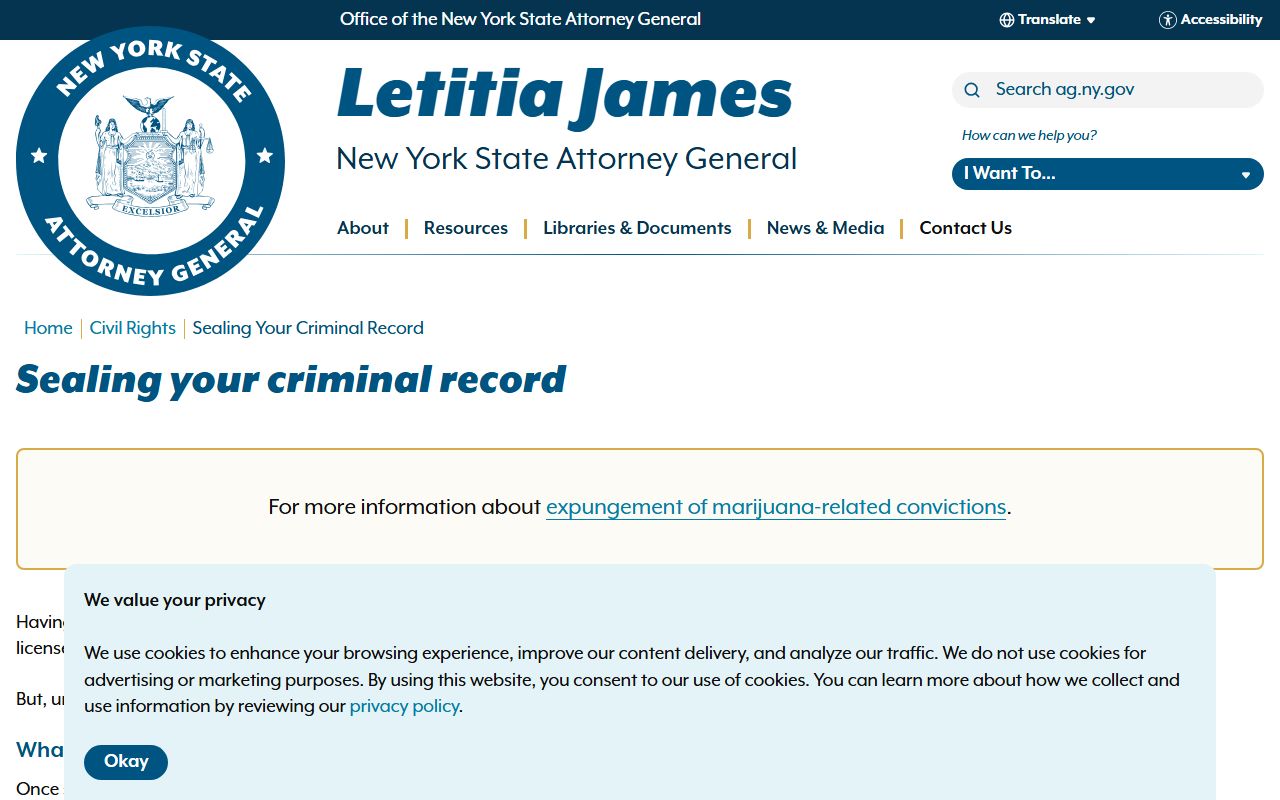
The guide walks through who qualifies and how to apply. It pairs with the court system's own sealing material, which is covered next.
Mugshots and Booking Photos
Monroe County's public jail reports do not include mugshots. The roster lists names and entry dates. The census adds charge, custody, and court fields. Neither carries a booking photo, a date of birth on every line, or a physical description. Booking photos may exist in the internal jail file, but they are not posted on the public custody reports.
That is a deliberate limit. New York has tightened rules on the release of booking photos. So a Monroe County arrest search will give you charge and custody data, not a gallery of faces. If you see a mugshot site claiming Monroe County data, treat it with care; those are private sites and are not the official source.
Statewide Criminal Records Search
For a charged case anywhere in New York, the state runs WebCriminal. It returns pending criminal matters by defendant name across participating courts. It does not show sealed cases, and it is not a full conviction history. For a Monroe County felony conviction, the County Clerk issues a certificate of disposition, the certified document that states how a case ended. The fee is $5, payable to the Monroe County Clerk.
Old eligible convictions can be sealed after ten years under CPL 160.59. The court system explains the process and the waiting period. The image below is from the NY Courts guide to sealing records after 10 years under CPL 160.59.
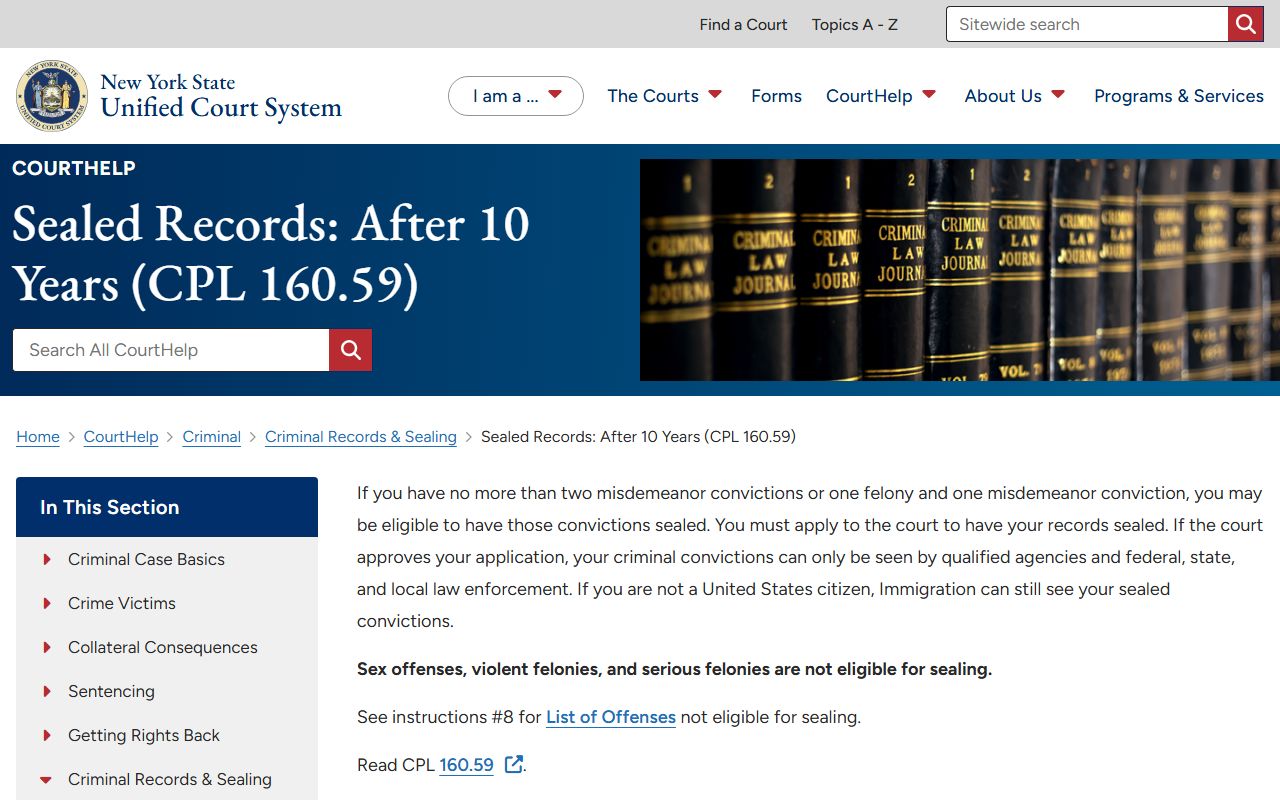
If a sealing petition is granted, the conviction is generally visible only to qualified agencies and law enforcement. The statute itself sets the eligibility limits and the offenses that can never be sealed.
Background Check Considerations
A casual name search is not a background check. A regulated background check, the kind used for jobs, housing, or credit, must follow the federal Fair Credit Reporting Act and New York rules. Those checks use defined sources and give the subject rights. Pulling arrest data off a public roster does not meet that standard, and using it for a hiring or tenant decision can break the law.
Important: This site is not a consumer reporting agency under the FCRA, and its data may not be used for employment, housing, credit, or insurance screening.
Restricted Criminal Records in Monroe County
Several categories are off limits to the public. Cases that end in favor of the accused are sealed under CPL 160.50. Certain violation and traffic infraction outcomes are sealed under CPL 160.55. The Clean Slate framework under CPL 160.57 adds automatic sealing for eligible convictions after a waiting period. Juvenile delinquency records are sealed under Family Court Act 375.1, and Family Court access is limited under Family Court Act 166.
The screenshot below shows the statute text for CPL 160.55, the sealing rule for violation and infraction dispositions.
Conviction-sealing eligibility is set by CPL 160.59, shown below. Grand jury material, sex offense victim identities under Civil Rights Law 50-b, and mental health clinical records under Mental Hygiene Law 33.13 stay confidential as well.
Note: An arrest that was sealed will not appear in public results, so a clean public search does not always mean a person was never arrested.